
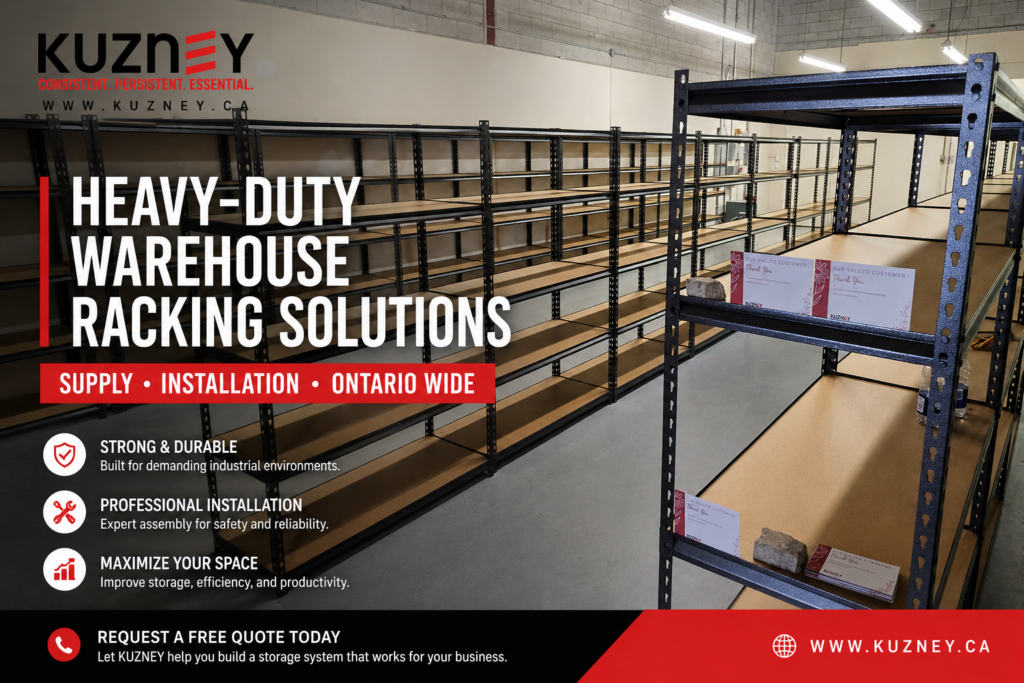
How to Choose the Right Warehouse Racking System for Your GTA Business
Choosing the right warehouse racking system is an important decision for any growing business. The right system can help you store more inventory, keep products organized, improve workflow, and make better use of valuable warehouse space.
The wrong system can create the opposite result. Poorly planned racking may lead to crowded aisles, wasted vertical space, difficult product access, and expensive changes later. That is why it is important to look beyond the price of the racking and consider how the full storage system will support your daily operations.
At KUZNEY, we help businesses throughout the Greater Toronto Area understand their warehouse storage needs and select practical solutions for current operations and future growth. This guide explains the main questions to consider before choosing warehouse racking for your business.
Planning a Warehouse Project?
KUZNEY can help you evaluate your available space, storage needs, inventory, and future growth plans.
Start with the Products You Need to Store
Before selecting a warehouse racking system, begin by reviewing the products and materials your business stores. Different items require different types of support, spacing, access, and load capacity.
Consider the size, shape, weight, and packaging of your inventory. Palletized goods may require warehouse pallet racking, while smaller boxes, tools, parts, or loose products may be easier to manage on industrial shelving. Long or irregular materials may require a different layout than standard cartons or pallets.
You should also consider whether the inventory is consistent or constantly changing. A business that stores the same pallet sizes throughout the year may have very different requirements from a wholesaler or distributor that regularly receives new product sizes.
Creating a simple inventory list before selecting racking can prevent costly mistakes. Record the approximate dimensions and weight of common loads, how many units must be stored, and how employees usually retrieve them.
Understand the Available Warehouse Space
Your warehouse dimensions will have a major influence on the right storage system. Measure the usable floor area, ceiling height, columns, doors, loading areas, fire equipment, electrical panels, and any other fixed features that affect the layout.
Many businesses focus only on floor space and overlook vertical space. A properly planned racking system can allow a warehouse to store substantially more inventory without moving to a larger building.
However, taller racking is not automatically the best solution. The height must work with your equipment, product weights, ceiling clearance, and operating procedures. It should also allow employees and forklifts to access inventory safely and efficiently.
A good layout balances storage density with practical movement. Filling every possible area with racking may create more storage positions, but it can also reduce efficiency if aisles become too narrow or products become difficult to reach.
Consider How Inventory Moves Through the Warehouse
The right warehouse racking system should support the way inventory enters, moves through, and leaves your facility.
Think about where deliveries are received, where products are checked, where they are stored, and how they are picked for customers or production. Frequently used products should generally be easier to access than slow-moving inventory.
If employees repeatedly travel across the warehouse to retrieve popular items, the problem may not be a lack of space. It may be an inefficient layout. Racking should help shorten unnecessary travel and create a logical flow between receiving, storage, picking, and shipping areas.
Businesses should also consider inventory rotation. Some products may require first-in, first-out handling, while other inventory can be stored without strict rotation. Understanding these requirements helps determine how products should be positioned within the warehouse.
Choose Between Warehouse Racking and Industrial Shelving
Warehouse racking and industrial shelving both provide valuable storage, but they are intended for different applications.
Warehouse racking is generally used for larger, heavier, or palletized loads. It is a practical choice for businesses storing bulk inventory, commercial goods, manufacturing materials, and products moved with forklifts or other equipment.
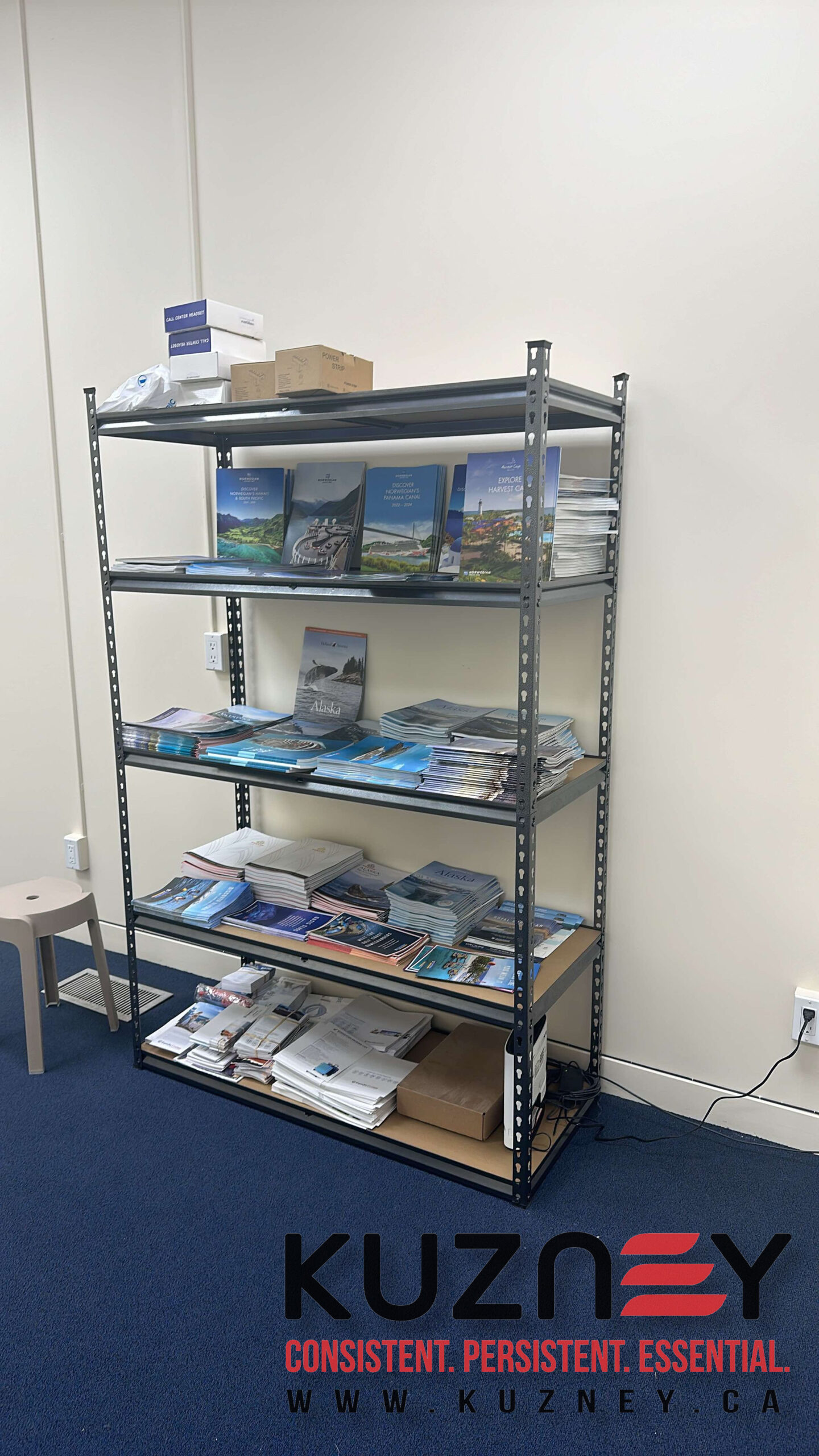
Industrial shelving is often better for smaller products, cartons, tools, parts, supplies, and inventory that employees access by hand. Shelving can work well in stockrooms, workshops, retail storage areas, and smaller warehouse operations.
Many businesses benefit from using both systems. Pallet racking can hold bulk inventory, while industrial shelving can be used for smaller items or order-picking areas. A mixed layout may provide better organization than trying to force every product into the same type of storage.
Review Weight and Load Requirements
Load capacity is one of the most important considerations when choosing warehouse racking. The system must be suitable for the weight of the products being stored, including the pallets, containers, and any other materials placed on the rack.
Do not estimate load requirements based only on how heavy a product feels. Record realistic maximum weights and plan for the heaviest expected load, not just the average load.
It is also important to understand how weight is distributed. A load concentrated in one area may affect a beam differently from an evenly distributed load. The racking configuration, beam length, upright height, and number of storage levels all influence the final system.
Never assume that two racks that look similar have the same capacity. Ask for proper product information and follow the recommended loading limits. Clearly communicating load requirements at the beginning of a project helps the supplier recommend a more suitable solution.
Plan for Forklift and Equipment Access
If your business uses forklifts, pallet jacks, ladders, carts, or other warehouse equipment, the racking layout must provide enough room for safe and efficient operation.
Aisle width should be based on the equipment being used, turning requirements, load dimensions, and how employees move through the warehouse. An aisle that looks wide enough when empty may become difficult to navigate once products, pallets, and equipment are in daily use.
Consider the height your forklift can safely reach, whether loads can be placed without contacting nearby structures, and whether operators have clear visibility. Loading areas and travel paths should remain organized and free from unnecessary obstructions.
Planning equipment access at the same time as the racking layout is much easier than attempting to correct narrow aisles after installation.
Think About Future Business Growth
Many businesses select storage based only on their current inventory. This may solve an immediate problem but create another problem within a year or two.
Consider whether your product range, sales volume, or warehouse operation is likely to grow. You may not need to install every possible rack today, but the layout should leave room for practical expansion when possible.
Ask whether additional bays, beams, or shelving levels can be added later. Think about whether the current layout would still work if inventory increased or new product categories were introduced.
An expandable warehouse racking system can help your business adapt without completely redesigning the facility. Planning for growth can reduce future disruption and protect the value of your initial investment.
Avoid Choosing Based Only on Price
Price is important, but the lowest initial cost does not always provide the best long-term value. A poorly suited storage system may require modifications, replacement parts, additional labour, or a complete redesign later.
When comparing warehouse racking options, consider product quality, suitability, installation, customer support, and whether the supplier understands your business requirements.
A better question is not simply, “What is the cheapest rack?” Instead ask, “Which solution will organize our inventory, support our workflow, and continue working as the business grows?”
The right system should provide value through better organization, improved storage capacity, more efficient product access, and fewer operational problems.
Professional Installation Matters
Even good warehouse racking can perform poorly if it is not installed correctly. Proper assembly, alignment, placement, and anchoring are important parts of a dependable storage system.
Professional installation can also reduce disruption by helping the project move efficiently from planning to completion. An experienced team can identify layout concerns, confirm component placement, and help make sure the completed system matches the intended design.
If you are expanding an existing racking system, the new components must also be reviewed carefully. Do not assume that components from different systems are automatically compatible.
Businesses should continue inspecting racking after installation and address visible damage, leaning, loose components, or impact from equipment promptly.
Common Warehouse Racking Mistakes
- Choosing racking before measuring the warehouse properly
- Ignoring product weights and load distribution
- Using too little aisle space for equipment
- Failing to plan for future growth
- Trying to store every product in the same type of system
- Buying based only on price
- Installing racking without considering workflow
- Overlooking regular inspections and maintenance
A thoughtful planning process can prevent many of these issues. The goal is not simply to fit more racks into the building. The goal is to create a warehouse that is organized, accessible, practical, and ready to support the business.
Why GTA Businesses Choose KUZNEY
KUZNEY provides warehouse storage solutions for businesses throughout the Greater Toronto Area. We understand that every facility is different, so we focus on practical recommendations based on the available space, products, workflow, and future plans.
Our warehouse solutions include heavy-duty warehouse racking, industrial shelving, layout planning, professional installation support, and expansion options for growing businesses.
Customers choose KUZNEY for dependable products, competitive pricing, friendly service, and a straightforward approach to commercial storage.
Frequently Asked Questions
How do I know which warehouse racking system I need?
Start with your product dimensions, weights, inventory volume, warehouse measurements, equipment, workflow, and future growth plans. KUZNEY can help review these factors and recommend a practical solution.
Can warehouse racking be expanded later?
Many systems can be expanded, but future expansion should be considered during the initial planning stage. Compatibility, available space, and the original layout all matter.
Do you provide warehouse racking installation?
Yes. KUZNEY provides professional installation support for warehouse racking and commercial storage projects.
Can industrial shelving and pallet racking be used together?
Yes. Many warehouses use pallet racking for bulk inventory and industrial shelving for smaller products, supplies, or hand-picking areas.
What areas does KUZNEY serve?
KUZNEY serves businesses throughout the Greater Toronto Area.
Build a Warehouse System That Supports Your Business
The right warehouse racking system should do more than hold inventory. It should improve organization, support efficient movement, make better use of space, and provide room for the business to grow.
Before choosing a system, review your inventory, warehouse measurements, load requirements, equipment, workflow, and future plans. Taking time to understand these factors can help you avoid expensive changes and create a more practical long-term solution.
Need Help Choosing Warehouse Racking?
KUZNEY provides warehouse racking, industrial shelving, storage planning, and installation solutions for businesses throughout the GTA.
Learn More About KUZNEY Warehouse Solutions
Explore our Warehouse Solutions page for information about racking, industrial shelving, layout planning, installation, and completed project examples.
You can also read our guide to heavy-duty warehouse racking for more ideas on maximizing commercial storage space.